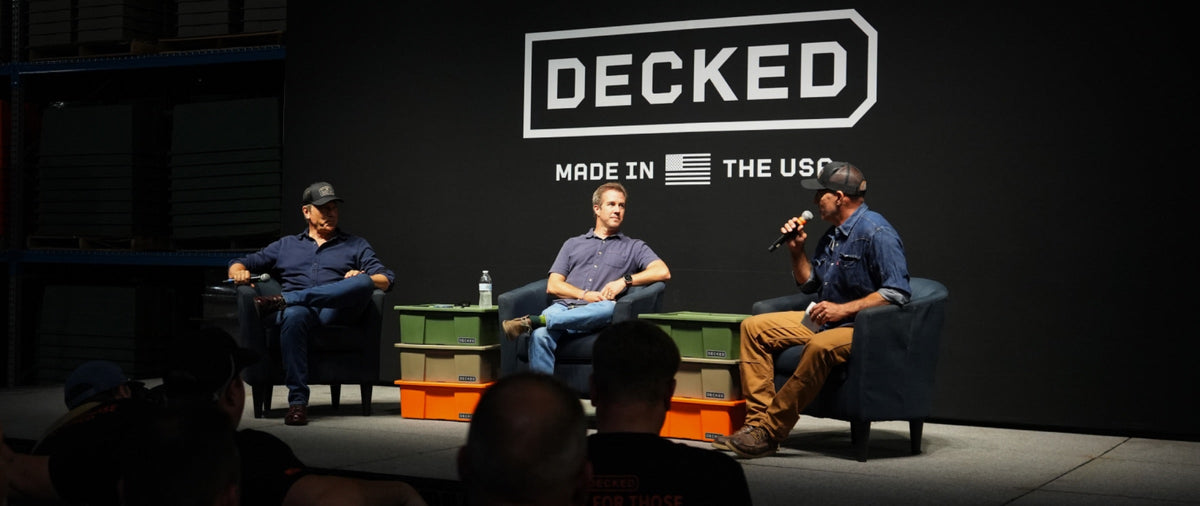
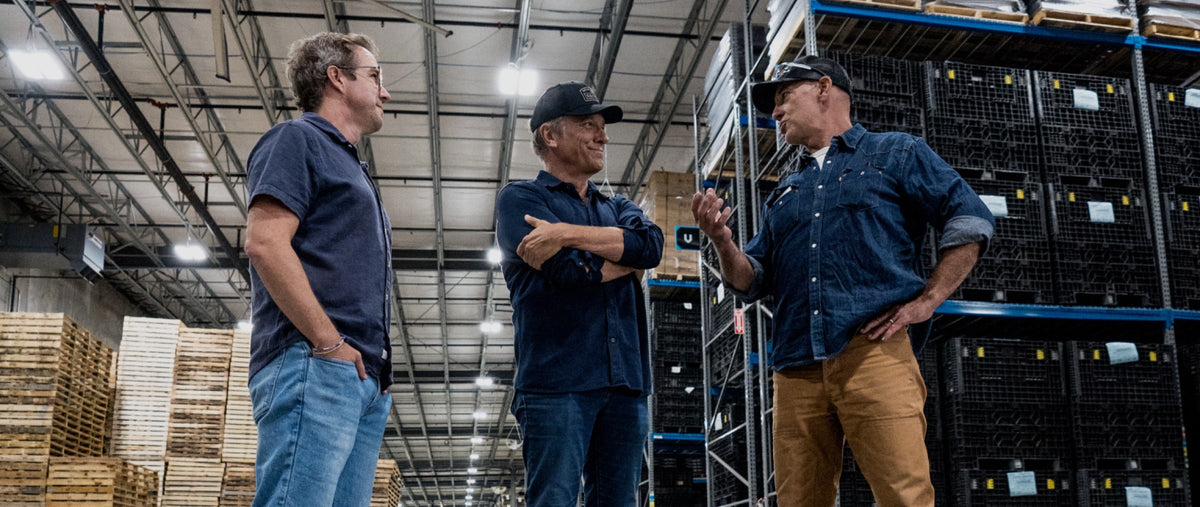
When we were planning our first-ever Builder’s Day at our factories in Defiance, Ohio, we knew we needed to kick things off with someone special. The only problem? You can count the number of “blue-collar celebrities” on one hand and, nothing against Bob the Builder and Bob Vila, but we had our sights set on one man: Mike Rowe.


Mike is a rare breed. He’s a celebrity and a genuine human being, someone who’s just as comfortable talking to congress and hosting national TV shows as he is mucking through sewers and shooting the sh*t with us average Joes. Considering that both DECKED and Mike have been rooted in the trades since day one, we couldn’t have found a better fit for the first-ever Builder’s Day.
And if that wasn’t enough, he cares. A lot. Just look at his work with the mikeroweWORKS Foundation:
- Over $22.5 million awarded in total work ethic scholarships. Supported more than 3,300 students and trade workers pursuing career technical training.
- Individual scholarship grants ranging from $600 to $25,000.
- Financial aid goes toward training programs across 20+ distinct skilled trades, including welding, HVAC, plumbing, carpentry, diesel technology, automotive repair, electrical work, and manufacturing.
- The foundation sets aside millions each year specifically for the Work Ethic Scholarship Program, including up to $10 million in dedicated scholarship campaigns.

If you only know this man from Dirty Jobs, you don’t know Mike. He’s truly an expert on the skilled trades industry — where it’s been, where it is now, and where we hope it’s going in the future. So, over an hour-long Q&A with DECKED CEO Bill Banta and DECKED VP of Marketing Greg Randolph, we talked about just that.
It was an incredible, illuminating, challenging, and encouraging conversation about our blue-collar industry, and we wanted to share some of it with you. Here’s a quick glimpse into our Builder’s Day conversation with the one-and-only Mike Rowe.


On Our Complicated Relationship With the Trades…
“What does the country really not understand about the trades, that's a 500-page book I haven't gotten around to finishing. But mostly I would just say it's our reliance on that part of the workforce. It's a stubborn reliance because we don't like to admit it—because to admit how much we rely on that part of our workforce is to admit how incompetent we are and how much we need them.”
Whatever it is about the human condition, over time, we wind up resenting the thing we rely on. We rely on you guys, we rely on the trades. For that reason, it makes us uneasy and uncomfortable when we have to wait three days for the electrician or the plumber. So it's a complicated relationship, but it's fun to watch."


On Blue Collar vs. White Collar…
“It's a binary choice, and binary choices are almost always sucker's bets, I think. What's happened—like that geometry kid versus the kid in shop class—once you get on a path, the roads start to diverge, and you get further and further apart from each other."
"In between the blue and the white collar, you get this gap. In my world, I think that's what the skills gap is. We've got 6 million open jobs in the country right now, 2.1 million in manufacturing and trades. Employers are competing and struggling like crazy right now to fill that gap. They're panicking. Not a week goes by that my foundation doesn't get a phone call from the leader of some big company or industry. I don't think we can keep going on with this blue-collar, white-collar mentality. I think the color of collars is over."
‘Blue collar’ and ‘white collar’ are rooted deeply in our brains. We all grew up with an understanding that there were two parts of the workforce, and we all grew up having essentially to choose, 'What am I?’"


On the Downfall (and Comeback) of Shop Class…
"Why would we tell a whole generation of kids that the best path for the most people is the most expensive path? Why would we take shop class out of high school? Why would we turn the jobs you've created into vocational consolation prizes? In the long history of modern education, nothing is ever going to go down in history as a more harebrained idea than taking shop class out of high school. That put a series of events in place that we're just now starting to understand. It's a problem."
"I've been saying this for a long time. What surprised me the last couple of years is that the ship is starting to turn around, and now parents, guidance counselors, and kids got a different memo. We have $1.7 trillion of outstanding student debt on the books."
"So yeah, there are stigmas, stereotypes, myths, and misperceptions, and my foundation works hard to debunk those. But there's also the incontrovertible truth of the math. These kids got that memo and did the calculus, and now they're betting they have a better shot at mastering a trade."
"Nothing in the history of Western civilization has gotten more expensive faster than a four-year degree. Not healthcare, not energy, not food, not real estate. Nothing. The cost of the thing that we told everybody to get is officially prohibitive. The cost of the certification that we desperately need is easily within reach, and my foundation and many others can help people get there."
"The gap is the story that we've failed to tell. We need to tell a better story."

For every five tradesmen who retire this year, only two step in to replace them. Five out, two in. It's been that way for well over a decade."
On Bridging the Educational Gap…
“I remember 10 or 11 years ago during a presidential debate, all 17 Republican candidates were on stage. Marco Rubio concluded an answer by saying, 'What our country needs are fewer philosophers and more welders,' and the crowd went wild."
"My social media exploded with thousands of people saying, 'Hey, this Marco Rubio guy is singing your song, isn't he?' I had to publicly say, 'No, actually, that's not what I'm saying.'"
"Our country right now is not actually suffering from too many philosophers. What we need are more philosophers who can run an even bead. What we really need are more welders who can have a serious conversation over a beer about the Stoics, the Socratic method, or thinking critically. If we want our kids to think critically, we can't just hand them a welding torch and say, 'Do this, then do that.”
"We've got to walk and chew gum at the same time, and maybe read some poetry along the way as well. Why is there no poetry in trade school? Why is there no HVAC at Harvard? Somebody's got to smash them together."

On the Onslaught of Trades Stereotypes…
"How come if we all close our eyes and imagine a plumber, we see the same 300-pound dude with a giant butt crack? Why do we have these images in our head?"
"The answer is decades of television, portrayals in thousands of books, and hundreds of thousands of commercials. We've seen college elevated at virtually every turn, and we've seen the trades as a punchline at virtually every turn. Now we scratch our heads and ask, 'How did we get such a skills gap? How did college get so expensive?'"
"Parents are scared to death. We've told an entire generation of kids to borrow whatever it takes to do the thing that sounds like fun. None of this is a coincidence, but I don't think any of it is a conspiracy either. I don't think there's some malevolent force in a corner twirling his mustache, laughing maniacally that their plan came true."
On How to Hire the Right Person…
"I saw this on Deadliest Catch, that crab fishing show has been on the air for 23 years. The first year up there, it was so violent. Six guys died, everybody I knew got hurt, and a boat sank. It was amazing TV, but it was a very difficult work environment. The greenhorns work so hard, don't get paid a lot of money, and are tough to find."
"I was really worried for the captains who had become friends of mine, wondering how hard it was going to be for them to find a greenhorn after the world saw how challenging crab fishing on the Bering Sea is. What happened at the beginning of season two was that people flew in from all over the country and stood on the decks for a chance to work as a greenhorn."
"Why would that happen? Not everybody did, but some did. This is the trick: you're trying to find the kind of people who respond to a challenge—people who look at something difficult or dangerous and say, 'Yeah.' You want the person who wants the ball in the bottom of the ninth when the bases are loaded. Give me that girl; give me that guy. They're hard to find."

We couldn’t be more thankful for Mike Rowe and his team’s involvement in Builder’s Day. As he pointed out, it’s going to be a long road to changing the perception of skilled trades in America, but the most important thing is to keep on keepin’ on, and that’s what we’re going to do at DECKED. This event is just one step towards a new era of our most essential industry and, judging by the faces we saw at Defiance, it’s going to be just fine. It’s just about putting in the work.